

- Why shape changes your sensations (and your results)
- Round, teardrop, diamond: profiles that really match
- Diagnostic express: 6 questions to help you make the right decision
- Summary table
- The “level” myth: form doesn’t rank players
- Other parameters to check
- Key takeaway
- Further information (useful sources)
Why shape changes your sensations (and your results)
In padel, the shape of the racket acts like a lever: it shifts the center of gravity and changes the inertia felt when striking the ball. At deuce weight, a racket can feel “lively” (low balance) or, on the contrary, “pull forward” (high balance). This is often where differences in control and power come into play… even before talking about sponge or surface.
In concrete terms, the shape is most noticeable in three moments: reflex volleys at the net, defending after glass (where maneuverability saves points) and over-the-shoulder shots (where inertia helps to accelerate). In other words: shape isn’t an aesthetic detail, it’s a sensory signing.
Balance: when the head “weighs” more than the set
The further the balance point comes back towards the head, the greater the inertia when hitting. The result: the ball comes out faster… but the racket is less easy to handle in fast exchanges (volleys, reflex defenses, counter-attacks on mesh fences). Conversely, a low balance favors maneuverability and shot repetition, at the cost of slightly less “free” power.
Sweet spot: the comfort zone isn’t in the same place
The sweet spot is the area where impact is both “cleanest” (less vibration) and most efficient (best energy restitution). When the ball comes out of the racket effortlessly and the feel remains stable, you’re in the sweet spot. Outside this zone, the stroke becomes harder, the trajectory degrades and accuracy drops.
To find it, hit 10 balls at medium speed against a wall or in warm-up, deliberately looking for three zones: center, top of screen, bottom of screen. The area that gives the most comfort and the smoothest ball output is your “real” sweet spot on this model. The wider the sweet spot, the more forgiving the racquet.
What the regulatory framework says
Whatever the shape (round, teardrop, diamond), racquets are subject to maximum dimensions in competition. For the curious, the official rules specify length/width/thickness limits and the general characteristics of the perforated surface(FIP rules).
Round, teardrop, diamond: profiles that really match
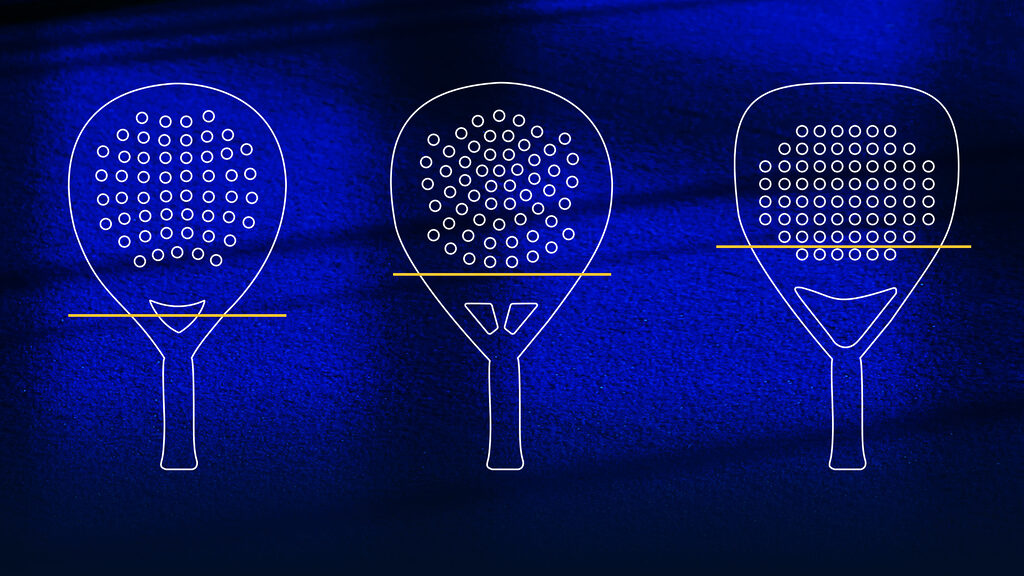
The round shape: safety first and foremost
The round racket generally places the balance lower, closer to the set. This is the shape that makes it easiest to feel in hand: trajectories are easier to control, there’s a better feel when blocking and putting, and the sweetspot is often wider and more centered. It helps you play clean, vary heights and build without rushing.
- Ideal if you prefer control, defense, positioning and long exchanges.
- Invaluable if you’re still lacking consistency on volleys and returning the glass.
- Something to watch out for: the sensation of “missing weight” on certain finishes (smash, pressed bandeja) if the transfer technique is not installed.
La goutte d’eau: reassuring versatility
The teardrop shape lies between the two extremes. The balance is closer to the center, with the sweet spot often a little higher than on a round, while remaining relatively forgiving. This is the “Swiss Army knife” shape: enough response to accelerate, enough stability to delay.
- Ideal if you alternate between defending and taking the initiative, with no single identity (100% attacker or 100% counter-attacker).
- Recommended if your level is progressing: it often accompanies the transition to a more offensive game.
- Watch out: two “teardrop” snowshoes can feel very different, depending on the exact weight and balance. Shape doesn’t tell the whole story.
The diamond shape: power, but not for free
The diamond comesback balance towards the head. The desired spin is clear: more inertia, more impact on shots above the shoulder and on “finished” balls. In exchange, the sweet spot becomes smaller and higher, requiring more reliable centering. The racket can also fatigue the wrist and forearm if the gesture remains tense.
- Ideal if you’re looking to finish points, especially on high balls and strong volleys.
- More suitable if the technique is stable and centering regular, especially under pressure.
- Watch out for fatigue and loss of precision as the arm slows down. Sometimes it’s better to drop the weight slightly rather than “force” with a head that’s too heavy.
Diagnostic express: 6 questions to help you make the right decision
Before changing shape “on impulse”, it’s best to start from the short term. Here’s a quick checklist to avoid impulse buying:
- Do your mistakes stem mainly from a lack of focus? If so, the round remains the most forgiving.
- Do you suffer on the volley when the tempo accelerates? A lower balance can restore timing.
- You build well but finish few points? The water droplet (or even diamond) can help gain in percussion.
- Do you like to play at the net and accelerate quickly? The water droplet often offers a better compromise.
- Do you live for the left-hand smash and high ball? Diamonds are more in line with this logic.
- Does your arm/wrist feel sore after matches? Avoid balances that are too high, or lower the overall weight.
Summary table
| Shapes | Detail |
|---|---|
| Round | Low balance, great forgiveness, centered sweet spot: priority to control and consistency. |
| Water drop | Median balance, versatility: an effective compromise for progressing and varying game phases. |
| Diamond | High balance, smaller and higher sweet spot: power and finish, requires more centering. |
| Points to watch | The higher the balance, the more demanding and potentially tiring the snowshoe becomes over time. |
The “level” myth: form doesn’t rank players
Reducing the shape to one level (round for beginners, diamond for experts) oversimplifies the reality. Confirmed players stick to round shapes to secure their consistency under pressure, while some intermediates prefer a teardrop shape to accelerate without losing their grip. The real question is not “which shape for which level”, but “which shape best stabilizes your game today”.
Other parameters to check
Once the shape has been chosen, other elements deserve a closer look: the exact weight, the measured balance, the feel in hand (grip) and the sensations on impact. Core, surface and roughness also count, although they are not the subject here. If you’re still hesitating between two models of equivalent shape, this guide to choosing the right padel racket will help you decide with a simple method.
Key takeaway
- Above all, the shape influences the balance, forgiveness and location of the sweet spot.
- Round: control and ease. Droplet: balance. Diamond: power and demands.
- The best shape is the one that stabilizes your game under pressure, not the one that “promises” the most.