
- Air padel: what are we really talking about?
- Why it can help: the brain loves repetitions… provided they are ‘precise’
- Load management, return, pain: air padel can help… but doesn’t ‘cure’
- What studies on imagery say: useful, but not magic
- Four variations of air padel (and when to use them)
- The anti-gadget method: 6 benchmarks that change everything
- Express routine (12–14 minutes) to do before or after the court
- Limits to know (and common errors)
- Key takeaways
- Further Reading
Air padel: what are we really talking about?
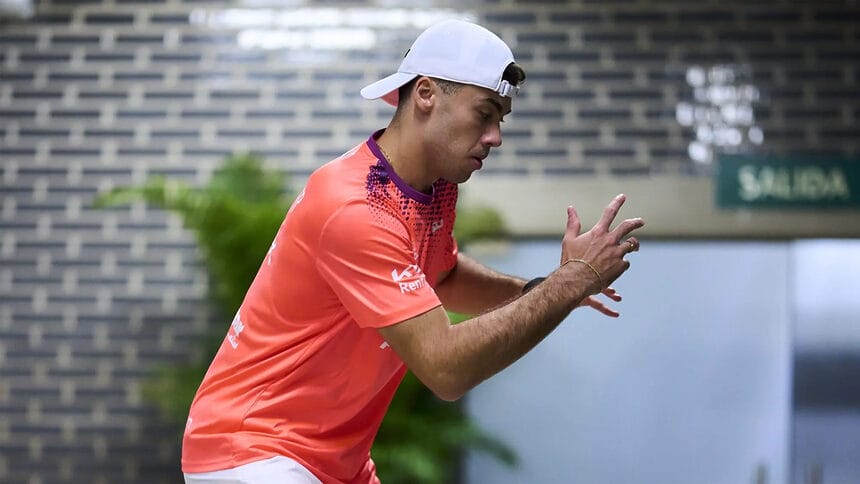
In clubs, it’s called by many names: ‘shadow’, dry runs, active visualization… The idea is simple: reproduce game sequences without actual exchange. The goal is not to ‘look pretty’, but to create a frame where you can isolate a detail (footwork, orientation, preparation, zone choice) without the noise of the rest.
Concretely, l’air padel brings together two complementary families:
- Motor imagery: you ‘play’ the point in your head, with maximum detail (tempo, trajectory, pressure, score).
- Blank repetition: you actually move (footwork + gesture), but without ball/racket contact.
Pros resort to it for a rather pragmatic reason: to multiply useful repetitions without adding fatigue, and maintain a sense of control over key patterns (move to the net, bandeja, vibora, wall defense, replacement).
Why it can help: the brain loves repetitions… provided they are ‘precise’
1) Stabilize benchmarks (before the shot, not during)
Many padel errors don’t come from a lack of strength, but from confused timing: preparation too late, no final adjustment, head moving, unstable outside footwork. In dry repetition, you can ‘freeze’ the right moment: split step, first step, shoulder/pelvis orientation, then finish.
2) Train decision-making, not just the movement
Padel is a sport of reading the game: speed, depth, wall, opponent’s position. Air padel doesn’t train the ball… but it can train the chain ‘I perceive → I choose → I execute’. This is particularly interesting for recurring situations: opponent’s lob on your bandeja, ball comes back off the wall on the backhand side, or point that closes at the net.
3) Gain volume without ‘loading’ the shoulder
For regular players (and not just pros), the shoulder and elbow take a toll when repeating too many smashes, viboras, or wall exits. Blank repetition allows increasing the number of technical sequences without adding the same mechanical stress as a real shot.
Load management, return, pain: air padel can help… but doesn’t ‘cure’
When chaining matches or carrying an discomfort (shoulder, elbow, lower back), the benefit of air padel is mainly simple: continue repeating useful sequences without adding dozens of shots. We maintain timing, footwork, preparation, and point routines, while limiting the mechanical stress which, in turn, ends up being costly.
But you have to keep the hierarchy in mind: air padel is not a treatment. In case of pain, the most solid logic remains a progressive and structured return to load, ideally supervised. Air padel can serve as a ‘bridge’ between rest and return to game, provided it remains painless and you quickly check on the court. If the discomfort persists or sets in, it’s best to seek advice from a sports health professional.
What studies on imagery say: useful, but not magic
In racket sports, imagery and structured repetition are often used as a complement. Research syntheses in tennis (close to certain padel patterns) report rather favorable effects on precision and certain technical aspects, with a level of certainty that remains cautious according to studies. In other words: it can help, especially if integrated into a coherent routine, but it doesn’t replace real ball training.
One point often comes up: the more the exercise resembles the real context, the more likely it is to transfer. This is the spirit of the PETTLEP model, which encourages sticking to the match across seven dimensions (posture, environment, task, timing, learning level, emotion, perspective).
Four variations of air padel (and when to use them)
| Feature | Detail |
|---|---|
| Without racket, without ball | Ideal for working on footwork, posture, rotations, and repositioning without shot ‘pollution’. Perfect for warm-up or return after pain. |
| Racket only | Useful for locking in the racket path (short preparation, elbow height, finish) on bandeja/vibora, and for feeling the balance at the end of the movement. |
| Ball in hand | Adds a tempo benchmark: you can synchronize throw/information gathering and imaginary ‘contact moment’, without unnecessary acceleration. |
| Racket + zone markers | The most ‘padel’: you mimic a point with visual targets (T, grid, corridor) and a clear intention (cross/long/short), even without hitting. |
The anti-gadget method: 6 benchmarks that change everything
- A realistic tempo: mimic at match speed. Neither permanent slow motion nor messy haste.
- One intention per sequence: ‘long bandeja on the backhand + repositioning’ is better than ‘I’m doing a bandeja’.
- The zone goal: choose a target (grid, T, corridor). Without a target, the exercise quickly becomes hollow.
- The ‘in-body’ perspective: imagine what you actually see (wall, opponents, space), not an external film.
- Feedback: 20 seconds of video are enough to check a detail (shoulder height, final footwork, torso orientation).
- Stop if quality drops: 6 clean repetitions are better than 30 approximate ones.
Express routine (12–14 minutes) to do before or after the court
Here is a simple format, designed to remain ‘padel-specific’ without dragging on:
- 3 minutes: blank footwork (split step + 2 steps + balanced stop), alternating net approach and defensive retreat.
- 4 minutes: ‘wall’ without racket: 4 sequences of 45 seconds (retreat, placement, mimed wall exit, repositioning), 15 seconds of recovery.
- 4 minutes: racket only: 2 blocks (bandeja then vibora), with a target announced before each block.
- 1 to 3 minutes: mini-scenarios: opponent’s serve, return, lob on you, point that closes. You play the point in tempo, as if the score mattered.
Tip: over a week, alternate one day ‘footwork’, one day ‘bandeja/vibora’, one day ‘wall defense’. Variety avoids repeating the same automatism in a loop.
Limits to know (and common errors)
Air padel has a virtue: it simplifies. And that’s precisely its first limit. Without a real ball, you lose some of the signals that guide your choices: speed, wall rebound, spin, depth, opponent’s pressure. You can repeat a clean sequence, but perception – what triggers the decision – remains incomplete. Without quick return to the court for validation, the exercise risks being ‘well done’… but out of context.
Second trap: dry repetition also engraves bad habits. Late preparation, collapsing footwork, too long a finish… eventually, it becomes your ‘norm’. Hence the benefit of only one instruction at a time, and minimal control: 20 seconds of video, a mirror, or a partner who confirms ‘yes/no’ on a specific detail.
Finally, pay attention to the tempo. Too slow ‘to feel’, or too fast ‘to look pro’: in both cases, the transfer to the match collapses. The rule is simple: if your air padel doesn’t resemble your padel, it won’t serve you long.
Key takeaways
- Air padel is useful if you maintain a logic: intention, tempo, zone benchmarks.
- Blank repetition mainly serves to stabilize footwork, preparation, and recurring decisions.
- A short and regular mini-routine is better than a long, ‘random’ session.
- It’s not a replacement for the court: it’s a quality accelerator between two sessions.
Further Reading
If you like to understand the ‘why’, three useful (and easy to find) readings:
- PETTLEP Model Update (ScienceDirect): how to make imagery closer to reality.
- Review and Meta-Analysis in Tennis on Imagery (PMC): what seems to improve precision, and what remains uncertain.
- Examples of shadow training focused on padel footwork: a court approach to structure your footwork.