
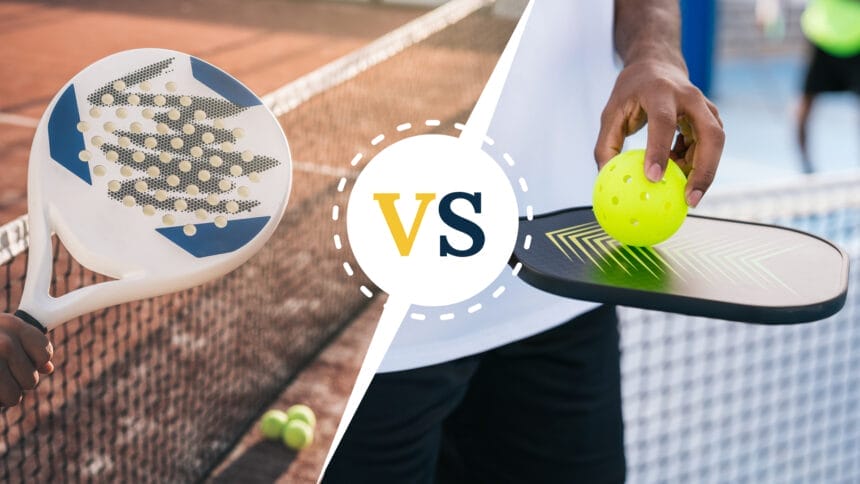
It’s the duel of the “new” racket sports. On one side, Padel, which has conquered Europe and Latin America with its glass walls and intensity. On the other, Pickleball, a true tidal wave in the United States, which attracts with its simplicity and ultra-social aspect.
In 2026, there’s still sometimes confusion: people talk about “paddle” for one, “pala” for the other, and they are often confused under the label of “accessible racket sports.” However, they are two distinct technical and sensory worlds.
Here’s how to never confuse them again and choose the one that suits you best.
1. The Court: The Cage vs The Open Court
It’s the most striking visual difference.
- Padel: Is played in a “cage” of 20m x 10m. It is surrounded by glass walls and mesh fence which are an integral part of the game. The ball can bounce off the walls and stay in play.
- Pickleball: Is played on a court the size of a badminton court (13.4m x 6.1m), without any walls. The boundaries are lines on the ground, like in tennis. If the ball goes beyond the line, the point is over.
2. The Equipment: Solid Racket vs Light Paddle
- The Padel Racket (Pala): It is thick (38 mm), weighs between 350g and 380g, and its surface is perforated with holes to reduce air resistance. Its core is made of foam (EVA rubber) to absorb shocks.
- The Pickleball paddle: It resembles a large ping-pong paddle. It is flat, thin, light (around 220g) and made of composite materials, carbon or wood. It has no holes.
3. The Ball: Rubber vs Perforated Plastic
- Padel ball: It’s a cousin of the tennis ball. It is made of rubber covered with felt, but with slightly lower pressure to limit the bounce.
- Pickleball ball: It’s a hard, hollow plastic ball, dotted with holes (between 26 and 40 depending on whether you play indoors or outdoors). It is much lighter and barely bounces if not hit.
4. Specific Rules: The “Kitchen” vs The Glass Walls
Each sport has its “signature” rule that defines its strategy.
- The Non-Volley Zone (The Kitchen) in Pickleball: It’s a 2.13m zone near the net where it is forbidden to smash or volley. This forces players to make small, technical, and placed shots (the “dinks”) rather than relying on brute force.
- Bouncing off the walls in Padel: The strategy relies on the ability to let the ball pass and play it after it hits the glass. It’s a game of patience and geometry.
5. Scoring and Serve
| Feature | Padel | Pickleball |
|---|---|---|
| Score | Tennis Format (15, 30, 40, Game) | 11-point set (win by 2) |
| Who scores? | Both teams | Only the server can score a point |
| Serve | Underhand after a bounce | Underhand, direct (volley) |
6. Physical Intensity
- Padel: Generally more demanding. The court is larger, rallies are longer thanks to the walls, and movements (jumps, lateral runs) are frequent.
- Pickleball: More accessible to people with joint problems. The smaller court limits long runs, and the focus is on reflexes and hand precision rather than pure endurance.
In recap: Which one to choose?
- Choose Padel if: You like complex strategy, powerful smashes, using the walls, and if you’re looking for a very cardio sport.
- Choose Pickleball if: You want a fun sport from the first minute, easy to learn, very social, and less traumatic for the knees.
Did you know? In 2026, many padel clubs now integrate pickleball courts on their sites, because both sports share a very strong social culture.
And you, are you more tempted by the geometry of the glass walls or by the tactical precision of the “kitchen”?