
- Before you sign: 9 points to keep in mind
- 1) Concept: indoor, outdoor, hybrid… and for whom?
- 2) Addresses and local residents: the visit that saves lost months
- 3) Site audit: what you don’t see on a visit
- 4) Permits: three regions, and one commune to decide
- 5) Noise and lighting: the blind spot that turns a backrest upside down
- 6) Court design: playability, maintenance, flow
- 7) Safety, accessibility, energy performance: the trio that keeps an eye on the club
- 8) Status and financing : ASBL or SRL, what’s next?
- 9) Stunning win: insurance, team, catering, data
- Conclusion
- Key takeaway
- Useful links (official)
Three regions, municipalities that examine each case individually, and a very high level of sensitivity to nuisances (noise, lighting, mobility). In this context, a padel club project isn’t just about the price of the work: it’s about preparation. Before calling in the contractors, here are the approvals you need to avoid returning to the drawing board, incurring extra costs and months of delays.
Before you sign: 9 points to keep in mind
Keep this grid handy: it recaps the logical order of decisions to be secured before committing to the first major jobs.
| Feature | Detail |
|---|---|
| Concept | Indoor/outdoor/hybrid, number of courts, services (changing rooms, pro-shop, catering) and target (leisure, competition, corporate). |
| Address | Check urban planning, mobility/parking and neighborhood sensitivity (housing, schools, quiet areas). |
| Site audit | Identify “hidden” risks: soil, water/flooding, easements, building diagnostics (renovation, high-risk materials). |
| Permits | Understand the regional frame, but above all the local requirements (town planning, environment where applicable, signs, lighting). |
| Noise & light | Anticipate nuisance: acoustic analysis, mitigation measures, orientation, schedules, controlled lighting plan. |
| Design | Validate slab, drainage, indoor headroom, safety around glazing, public circulation and maintenance access. |
| Compliance | Fire/evacuation, accessibility, technical controls, energy requirements (PEB/EPB) depending on region and nature of work. |
| Status | Choose ASBL/SRL (or partnership), organize governance, financing and administrative obligations (VAT, UBO, etc.). |
| Stunning win | Insurance, maintenance, staff, house rules, and if refreshment: AFSCA obligations, music, RGPD, cash register. |
1) Concept: indoor, outdoor, hybrid… and for whom?
The classic trap is to “do as the others do” without defining the club’s identity. In Belgium, the indoor/outdoor choice has immediate repercussions on local acceptability, opening hours, lighting, energy costs and administrative support.
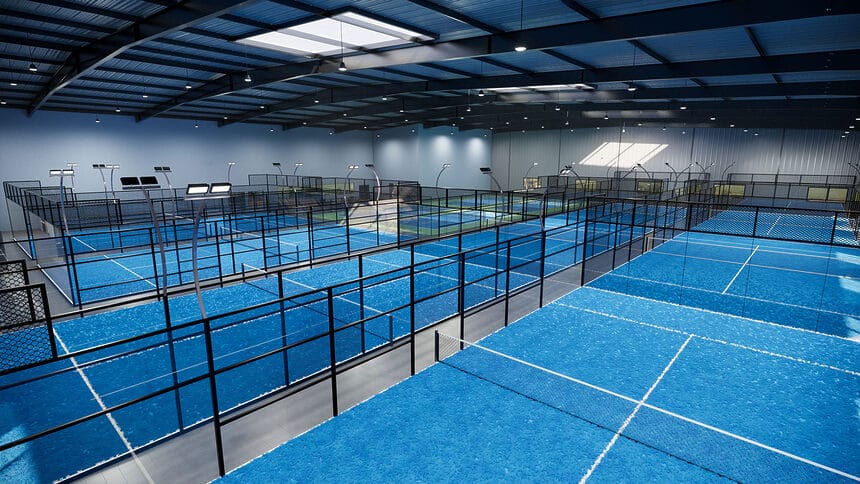
- Indoor: generally easier to defend in terms of noise, but more demanding in terms of headroom, ventilation, fire safety and energy performance.
- Outdoor: more sensitive to neighborhood complaints and local constraints (hours, light, traffic), especially near housing.
- Hybrid: commercially interesting, but requires operating discipline (rules, slots, events) to avoid the “everyone out until late” effect.
Another structuring question: are you a club (associative life, interclubs, sports coaching) or a center (rentals, events, businesses)? The cursor influences governance, staffing, financial planning and possible partnerships.
2) Addresses and local residents: the visit that saves lost months
A good location is more than just an available building. The trio to validate: urban planning, mobility, neighborhood.
What to check even before your first visit
- The destination of the zone and local requirements (sports, leisure, residential, etc.).
- Access: roads, transportation, pedestrian paths and parking capacity (customers, staff, tournament days).
- The “sensitive radius”: homes, schools, rest homes, quiet areas – all points where noise is perceived more quickly.
A simple tip: visit the site at its peak hours (evenings, weekends). That’s when you’ll see the traffic, the annoying light points and the “spin” at the entrance.
3) Site audit: what you don’t see on a visit
Before a lease, a purchase or a promise, it’s often the invisible constraints that cause a budget to slip. The site audit must answer one question: what can get in the way – or cost a lot of money – once the project is underway?
- Soil and industrial liabilities: depending on region and history, obligations may apply in the event of pollution or change of use.
- Water: flood zone, rainwater management, drainage (decisive for away).
- Easements and access: passages, technical constraints, fire department access, limits in relation to the public domain.
- Renovation: structural condition, electrical compliance, and diagnostics for old buildings (materials at risk, specific work).
The goal is not to pile up documents, but to avoid the “perfect site” scenario, which becomes a lengthy construction site as soon as you open the walls.
4) Permits: three regions, and one commune to decide
The reflex to adopt: the Region sets the frame, but the commune makes the difference in terms of content, method and timetable. Early discussion with the town planning department (and, if necessary, the environment department) is the most effective way of avoiding unpleasant surprises.
Wallonia: a frame and recommendations dedicated to padel
Wallonia has published a practical guide to the construction and operation of padel courts. One point to note is that padel courts are not ranked for the purposes of environmental permits, but local authorities can regulate noise via their police regulations, depending on the local context.
In Flanders: a focus on “omgevings” aspects
In Flanders, the administration has published a “leidraad” dedicated to the environmental aspects of padel (noise, light, integration). It also points out that the establishment of courts and certain facilities (screens, additional structures) may require authorization, with nuances depending on the case.
In Brussels: urban density, integration and nuisance
In Brussels, density changes the equation: flows, surroundings, landscape integration and the immediate neighborhood all play a greater role. In a lively neighborhood, the difference often lies in the details of operation (opening hours, lighting, access organization) as much as in the plans.
5) Noise and lighting: the blind spot that turns a backrest upside down
In many communities, it’s not the glazing or cladding that triggers a debate, but decibels, hours and light. The earlier you address these issues, the more serious your project will appear – and the more you avoid the “club versus local residents” match.
To be framed in black and white
- A site-specific acoustic analysis (distance, reflective surfaces, prevailing wind, reverberation).
- Mitigation measures: screens, court organization, buffer zones, and operating rules (schedules, events, tournaments).
- A lighting plan: controlled power, orientation of floodlights, gradual dimming and glare control.
The right thing to do: include noise and light in the design brief, not as an “after the survey” discussion.
6) Court design: playability, maintenance, flow
A padel court is sold on the quality of the game, but pays for itself in durability and use. Quotations don’t always detail the points that make all the difference in practice.
- Base and stability: flatness, durability, humidity management, drainage in away areas.
- Indoor headroom: too low a ceiling spoils the experience, and therefore loyalty.
- Lighting in the game area: ball visibility, uniformity, absence of shadows and glare.
- Circulation: waiting areas, safety behind walls, maintenance access, reception logic at peak times.
For guidelines on dimensions and layout, please consult our guide: Official dimensions of a padel court: essential guidelines.
7) Safety, accessibility, energy performance: the trio that keeps an eye on the club
An installation can be modified. Non-compliance, on the other hand, comes back like a boomerang (controls, insurance, corrective work). From the outset, think :
- Fire safety and evacuation: capacity, pathways, signage, safety lighting, technical areas.
- Accessibility: access, circulation, sanitary facilities and logic of use (not just “ticking a box”).
- Energy requirements (PEB/EPB): vary by region, type of work and configuration. A poorly dimensioned ventilation/heating indoor will cost you every month.
8) Status and financing : ASBL or SRL, what’s next?
Behind an identical façade, two models can be opposed:
- ASBL: associative logic (members, general meeting, sporting goals), relevant if club life is central.
- SRL: entrepreneurial logic (investment, growth, associates, bank financing), frequent for multi-terrains centers with services.
Whatever your choice, make sure your articles of association are consistent with your actual operations (courses, events, partnerships, catering), as well as the basic administrative obligations (entries, VAT parameters, UBO register, etc.).
9) Stunning win: insurance, team, catering, data
Opening is one step. Sustainability is the real issue. Solid “operational” preparation avoids blind spots after the inauguration.
- Insurances: civil liability, building, glass breakage, event coverage and, depending on the configuration, specific guarantees to be validated with your insurer.
- Maintenance: cleaning plan, wall control, surfacing, net, lighting, and injury prevention through clear circulation zones.
- Team: reception, entertainment, maintenance, coaching. If you’re aiming for competitions, you’ll also need to organize the necessary sports coaching and affiliations.
- Reservations and payments: your tool also becomes a “black box” in the event of disputes (data, cancellations, billing, RGPD).
How about adding a refreshment bar?
In Belgium, as soon as you get involved in the hotel and catering industry (however modest), you open up a sanitary and organizational section: hygiene, traceability, allergens, internal procedures and personnel management. It’s a good idea to include this in your business plan.
Conclusion
Setting up a padel court in Belgium is not a simple equipment operation: it’s a project where local acceptability, authorizations and operating conformity are just as important as the choice of courts. The safest method is to lock in the address and audit the site, then build a solid case on nuisances, before committing the big jobs.
By proceeding by “locks”, rather than by enthusiasm, you reduce the number of upsets, secure your timetable and arrive in front of your partners (municipality, bank, investors) with a coherent project.
Key takeaway
- In Belgium, a padel project is often won on three counts: authorizations, nuisances and stunning win.
- Treat noise and lighting as design choices, not a last-minute discussion.
- Before making any large-scale estimates, secure the address (urban planning + mobility) and audit the site.
- If you add a refreshment area, you must immediately take into account health requirements and operational realities.