
From the promise of Breton tennis to the real fork in the road
A player trained in the demands of tennis
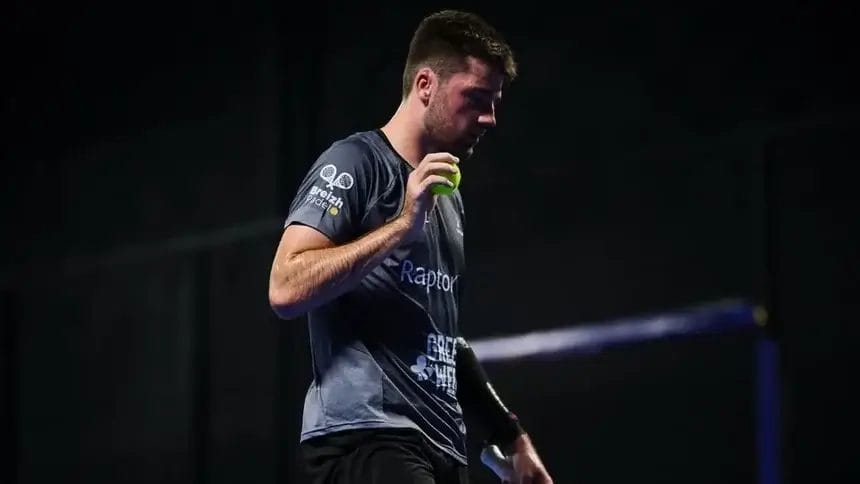
Before being identified as one of the leading names in French padel, Dylan Guichard first learned the logic, codes and constraints of tennis. In Rennes, he grew up in a competitive environment where progress is measured by regularity, hard work and the ability to last. This is a key factor in his career, as it explains much of what he will become on the track.
A future that seemed unwritten
In Breton tennis, Guichard wasn’t just a passing player. He was Brittany champion in 2016 and ranked 2/6, which already placed him in a category that was closely followed at regional level. At the time, it looked as though the next step would be taken with tennis racket in hand. His profile evoked that of a serious, diligent competitor, capable of advancing step by step, without spin or unnecessary fuss.
At that time, his future was not limited to a sporting career. Dylan Guichard had also set his sights on demanding studies, with a trajectory that could have been written elsewhere than on the slopes. This detail sheds a different light on his career path: nothing was totally written, either in tennis or elsewhere. His turning point to padel takes on even greater significance, because it tells less of a destiny mapped out in advance than of a gradual construction, nourished by choices, discoveries and opportunities.
And that’s precisely what makes what follows so interesting. His switch to padel wasn’t a spectacular break, still less an opportunistic reconversion. Rather, it’s the gradual shift of a player looking for the court where his qualities can be fully expressed and where a high-level project seems, in the long term, more realistic.
Rennes and the birth of another trajectory
The first turning point came in Rennes, where Dylan Guichard gradually discovered padel before turning it into a real investment court. Like many tennis players, he approached the sport almost as a sideline. Padel began as a curiosity, then as a game that hung in there, before becoming a real project. This chronology is important, because it shows that the transition wasn’t decided in a weekend.
From 2018 onwards, padel became an increasingly important part of his daily life. Gradually, the center of gravity of his career shifts. Here again, the course remains consistent with the character: no great manufactured narrative, no theatrical turning points, but a rise in conviction. Tennis had given him a base. Now padel offered him a perspective.
This pivotal moment in his history is essential. It shows that Dylan Guichard hasn’t just changed his discipline; he’s also changed his horizons. Padel has opened up a new circuit, even more accessible for an ambitious Frenchman, while at the same time requiring a new approach to learning: finer reading, duo management, a different understanding of tactics, repetition of sequences under pressure. This is where his profile really begins to take shape.
Madrid, the choice that turns a career around
For a French player who wants to make his mark outside France, a spell in Spain is often a decisive acceleration. Dylan Guichard was no exception. His move to Madrid marks a clear change of dimension. It’s no longer just a question of doing well in France, but of settling into an environment where the level of the game, the density of opposition and the demands of training impose a different standard.
The move speaks volumes about his ambitions. Going to Madrid doesn’t just mean changing training locations. It means agreeing to put his level to the test every day. It also means taking on the logic of a professional player, with all that this implies in terms of volume, repetition, adaptation to partners and the ability to string together tournaments.
In this frame, Guichard is refining his identity as a right-side player. His game is built around solidity, reading the game and continuity, without trying to create an artificial image of a spectacular player. This sobriety suits him. It also gives coherence to his progression.
Time for confirmation, between the French circuit and the international scene
Initial results validate the project
When results come, they don’t just fall from the sky. In 2022, Dylan Guichard was already having a season that was attracting attention: quarterfinals at the French Championships, victory in the P2000, entry into the world’s Top 200. At the time, he was still in the building phase, but something was changing in the way he was viewed. He was no longer just a former good tennis player who had turned to padel; he was becoming a competitor capable of producing performances that would stand the test of time.
This progression has a rare merit: it remains legible. It’s not based on a single stroke of brilliance, or on a week that would give the illusion. It’s built by piling on, by regularity, by repeating good outings. In a sport where associations evolve rapidly and cycles can break abruptly, this continuity is already worth a great deal.
Guichard soon ceased to be just another interesting name. He became one of those players we watch with real attention, because they can make their mark on major French events and start to make their mark on the international rankings.
From lost finals to a status-changing title
The French circuit then served as a breakthrough. Dylan Guichard came close to the top before he got there. He first lost two finals at the French Championships, first alongside Jérémy Scatena, then with Maxime Forcin. These are important milestones, because they’re as much about frustration as they are about learning. Being there so often, but not yet finished, also forges a career.
The turning point came in 2025. In a tight final against Bastien Blanqué and Nicolas Rouanet, he teamed up with Manuel Vives to win the French title. This first national title had a far-reaching impact. It validates several years of progress, closes the period of missed finals and puts him in another dimension on the French padel scene.
From then on, his career was no longer that of a player awaiting confirmation. It became that of a Frenchman at the very top of his game, with a major title under his belt and a reinforced legitimacy in the national hierarchy.
The FIP ranking, proof that upward mobility is no longer confined to France
This change in dimension is now reflected in the FIP rankings. Dylan Guichard recently found himself propelled to the top of the French international rankings, proof that his progress is no longer limited to the national frame. His official profile now places him at the doorstep of the world’s Top 100, in a zone where every tournament counts double: for status, for access to the tables and for credibility on the tour.
The recent period confirms this trend. With Bastien Blanqué, he took a set from Arturo Coello and Agustín Tapia in Riyadh, an episode which is obviously not a definitive turning point, but which puts a player on the map. Meanwhile, Dylan Guichard also shared several important weeks with Belgian Clément Geens, notably on the Cupra FIP Tour. Together, they strung together a number of interesting results, including a semifinal in Agadir, a joint appearance on other high-level tables at the start of the season, and above all a title in Houten, Netherlands. Here again, the interest lies in more than just the trophy: it can be seen in the repetition of benchmarks, the Franco-Belgian complementarity and the ability to exist in a variety of international contexts.
Guichard is no longer a shadowy figure. His name is now circulating with a different density, because he ticks several boxes at once: a player with a tennis background, structured, capable of performing in France, earning points internationally and staying in the conversation when people talk about the best French players of the moment.
The hardest part: lasting, settling in, confirming again
The present of a player who has changed category
Perhaps the most interesting thing about Dylan Guichard is that his career is now entering a more complex phase. Breaking through is one thing. Settling in is another. His status has changed: he’s no longer just the former Breton tennis hopeful who turned out well in padel. He is a player who is expected, observed and identified as one of the best French representatives on tour.
This new status inevitably brings a different reading of his seasons. Every result carries more weight. Every association is scrutinized. Every not-so-good period can be read differently. This is also the price to pay when you have left the register of promise to enter that of confirmation.
Her inclusion in the French squad for the 2025 European Championships is a step in the same direction. It shows that his progress is not just individual or statistical. It also counts in the construction of the French team, where the question is no longer whether he has the level to be watched, but how far he can push his ceiling.
The Top 100 in your sights, but not just as a slogan
The next milestone is quite clear: to break into the world’s Top 100 and stay there. This threshold is symbolic, of course, but above all it has a very concrete door. It changes the relationship with the tables, the nature of the weeks on tour and the way a player builds his season. For a French player, reaching it on a permanent basis also sends out a strong message about the ability of padel in France to place its players higher.
In Guichard’s case, this goal is not a hollow phrase. It’s part of a trajectory that’s already underway. At this level, the hardest thing is not so much to reach a ranking zone as to stay there. It’s all about repetition, accepting variations in form, making the right choice of partners, capitalizing on favorable weeks without letting the others slip away.
This is undoubtedly where the most important part of his story will be played out. Not simply in the story of a breakthrough, which has already taken place, but in the way he transforms this breakthrough into a lasting presence at the highest level of international padel.
What his story has to say about French padel
Deep down, Dylan Guichard’s story is much broader than his own. His itinerary illustrates the way in which French padel is growing up: still fed by profiles from tennis, but now obliged to confront Spanish standards to hope to reach a real milestone. His career path links these two worlds. Starting with a classic training background, he makes an intelligent transition, then hardens in the circuit’s densest ecosystem.
This trajectory makes him interesting beyond his current ranking. It makes him a landmark of his time, in a French padel industry that is no longer just looking to exist at home, but to place its players higher and longer on the international map.
Key takeaway
- Dylan Guichard first built his career in tennis, with a Brittany champion title in 2016 and a 2/6 ranking.
- He discovered padel in Rennes before gradually turning point to this discipline from 2018.
- His move to Madrid marked a key stage in his professionalization.
- After losing two finals, he became French padel champion in 2025 with Manuel Vives.
- His progress in the FIP rankings has recently propelled him to the very top of the French hierarchy.
- In recent months, he has also shared several international tournaments with Belgium’s Clément Geens, culminating in a FIP Bronze title in Houten.
- The next challenge is clear: to break into the world’s Top 100 and stay there.