

- Padel tournaments in Belgium: what you need to know before signing up
- The first point to understand: in Belgium, a padel tournament does not read the same everywhere.
- Tournament pyramid: regional first, then national
- Which series should you sign up for when you’re just starting out?
- How does a tournament actually work?
- The real crux of the matter: entries
- How much does a tournament in Belgium cost?
- The right frame of mind for a first tournament
- Key takeaway
- Official references and useful reading
Padel tournaments in Belgium: what you need to know before signing up
In Belgium, getting into the game isn’t just a matter of choosing a club to organize a padel weekend. For a new member, the first step is to understand the logic of the system: the national tour exists, but most of the first steps are taken on the regional circuits, with access rules, series and formats that differ slightly depending on whether you’re playing in Flanders or Wallonia-Brussels.
This is precisely what can make the early days a little fuzzy. There are P50, P100, P250 and P500 categories, entries that close a week beforehand, groups and final stages, and sometimes costs that go beyond the entry fee. So before even looking at the date of a tournament, it’s a good idea to check three things: your federation, your starting ranking and the series that really suits your profile.
In 2026, official tournaments in Belgium will be part of a well-established calendar: on the French-speaking side, Padel Wallonie-Bruxelles competitions run from January to the end of November, while the national Lotto Belgian Padel Tour has already set several stages for the spring and autumn.
To make this landscape easier to understand, here is a summary of the essential points to know before making your first entries.
| Feature | Detail |
|---|---|
| First things first | Check your affiliation, federation and starting ranking before making any entries. |
| Entry-level circuit | For a new player, the real training ground is regional tournaments, not the national circuit. |
| Pitfalls to avoid | Registering in the wrong series or ticking too few availabilities complicates everything, sometimes right from the start. |
| National horizon | The Lotto Belgian Padel Tour does exist, but it serves mainly as a benchmark for the top of the pyramid. |
The first point to understand: in Belgium, a padel tournament does not read the same everywhere.
Seen from afar, the Belgian system seems simple: you take out your licence, look for a tournament, then register. In practice, however, you have to look first at the regional circuit before looking at the big match-ups. Belgium operates on a national frame, but the actual entry into the competition is mainly via the regional federations. In Flanders, the player enters mainly via the CUPRA Padel Tour of Tennis en Padel Vlaanderen. In Wallonia-Brussels, they enter through the official Padel Wallonie-Bruxelles tournaments.
This is important for a new member, because reading habits are not exactly the same. Categories, entry procedures, group schedules, costs and even the way in which series are presented may vary. The right thing to do is not to look for “the first available tournament”, but to understand the environment in which you are registering.
Another useful clarification: this guide does refer to tournaments. Interclubs are an important part of the Belgian padel scene, but they follow a different logic: team and club-based. For players wishing to discover competition in pairs, the tournament remains the clearest door to entry.
Tournament pyramid: regional first, then national
The foundation: regional tournaments
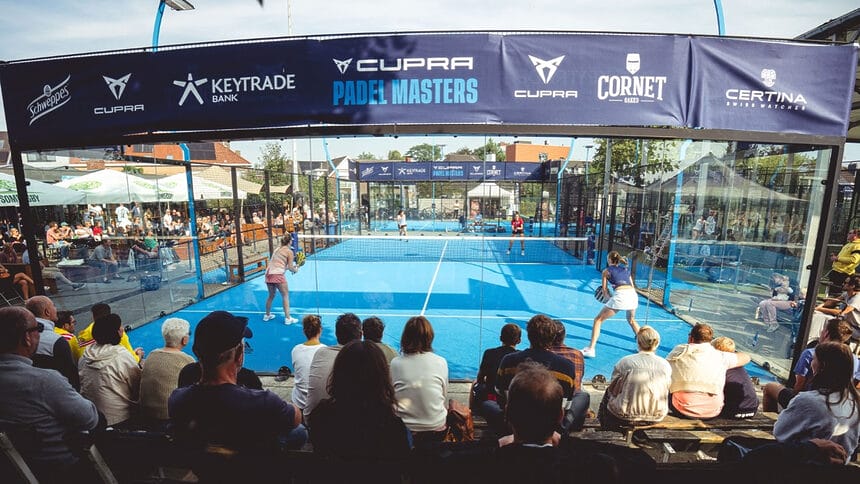
For a player who has just become affiliated, the center of the game is regional. This is where you learn how to read a table, manage a group stage, string together several matches in a tight time slot and situate yourself in relation to the rankings. On the Flemish side, the CUPRA Padel Tour is clearly positioned to offer a circuit for all levels, from the first-time competitor to the regional headline act.
This point changes the way the subject is presented. A “complete guide” should not sell prestige too quickly. Above all, it must explain how a licensee enters the system, without rushing through the stages. The right tournament is not the one that impresses, it’s the one that matches your starting level and availability.
The summit: the national circuit
Above this is the Lotto Belgian Padel Tour, a national circuit organized throughout the country. In 2026, several stages have already been identified, including Arenal Verrebroek from March 9 to 15, Tero Namur from May 18 to 24, and an announced Walloon stage from October 5 to 11, yet to be officially confirmed. In the Belgian landscape, this circuit serves above all as a benchmark for understanding the competition hierarchy. It attracts profiles already established in the higher series, with a more direct format and higher sporting standards.
Put another way: a new licensee should be aware of its existence, identify its dates and understand its role, but rarely consider it as his or her first step.
Which series should you sign up for when you’re just starting out?
This is the real question, and probably the one that wastes the most time for new players. In Flanders, the answer is clear: a player with no tennis ranking and no competitive padel background starts at P100 for men and P50 for women. In fact, the CUPRA Padel Tour presents the P100 as the beginner level, while the P50 is designed as an entry level for women.
In Wallonia-Brussels, the initial ranking follows the same starting logic for new affiliates: P100 for men, P50 for women. Secondly, the 2026 regulations for the French-speaking circuit show a series architecture that should be read carefully when choosing a tournament. For a new member, the healthiest rule remains the same on both sides of the country: start from your official ranking, then choose a coherent series, not a fantasy series.
There’s also a distinction to be made between ranking and rating. The ranking determines the series in which you can play. Ranking, on the other hand, is used to order performances over time. So, for a beginner, the first question is not “how many points will I score?”, but “in which table do I have the right and the interest to enter?”.
How does a tournament actually work?
On this point, education is just as important as the rules. In Flanders, the standard format is very straightforward: groups of three or four pairs, with at least two or three matches guaranteed, followed by a main draw with single elimination for the best teams. This makes a big difference to the experience of a first tournament. You don’t come for a one-way trip; you generally come to play several times in the same slot or over the same weekend.
The French-speaking circuit also follows the logic of a group stage followed by a draw, with a format that varies according to the series. In the basic categories, the first rounds are often played in a 9-game set, before a longer format as the game progresses. For a new member, this detail is not anecdotal: it determines the time spent at the club, the intensity of the weekend and the way you organize yourself with your partner.
The point I want to make to the reader is simple: not all tournaments are the same, even if their etiquette seems similar. Between an entry series, a denser field and a long-format end of the streak, the sporting and logistical load is anything but abstract.
The real crux of the matter: entries
The first mistake new licensees make is not their level. It’s that entries are treated too lightly. In Flanders, you have to choose your series, select your partner and, above all, declare your availability. The federation requires you to select a minimum number of group slots and to be available for the final stage. This is not an administrative detail: it’s a condition of the tournament.
On the French side, the registration calendar is clearly framed: entries close four weeks before the end of the tournament, on Monday morning, and close seven days before the start of the event. The rules also set a minimum number of pairs to maintain a category. For a player new to the competition, this means one very concrete thing: don’t wait until the last minute, and check that the chosen series has a real chance of being held.
Another often underestimated point is the pair. In Belgium, you don’t just register as a player, you register as a pair. The tournament doesn’t just judge your desire to play; it also reads the sporting coherence of your association, your cumulative ranking and, depending on the case, your priority for access to the series.
How much does a tournament in Belgium cost?
The cost is not uniform, but that doesn’t mean it’s opaque. In Wallonia-Brussels, regulation 2026 clearly sets out the amounts charged per person, with a standard range and a possible higher margin for full indoor organizations in winter. This is useful information for a reader hesitating between several clubs.
In Flanders, a distinction is made between the entry fee charged by the club and the federal contribution. For adults, a servicekost is added for the year, and another for each tournament entry. This is not necessarily what a new member anticipates at first click, so let’s be frank: the entry budget is not always limited to the rate posted by the organizer.
The right frame of mind for a first tournament
The first tournament doesn’t have to be spectacular to be successful. Above all, it has to be easy to understand. A suitable series, a reliable partner, slots that are actually available and a club that clearly announces its schedule are often enough to make the experience a positive one. On the other hand, setting your sights too high or being completely in the dark quickly turns a discovery into a frustrating weekend.
Readers should also understand that a padel tournament in Belgium is not just another official match. It’s a way of entering the competition, with its own codes, tempo, vocabulary and logic of progression. The rankings are recalculated during the season, the results end up moving your real place, and reading the streaks becomes more intuitive after a few well-chosen events.
For this, it’s worth putting the subject into a wider context: Belgian padel has changed scale in recent seasons, which explains the gradual structuring of circuits, rankings and bridges between levels. On this point, you can also reread our analysis of Belgian padel in 2026 for a better understanding of the background to these tournaments.
Key takeaway
- For new players, regional tournaments are the real door to padel competition in Belgium.
- The starting ranking determines everything: the series chosen, the level of the table and the chances of having a coherent first tournament.
- Belgium’s padel scene is not a single block: Flanders and Wallonia-Brussels have similar, but not identical, frames.
- A good first tournament is based as much on level as on format, cost and the actual availability of the duo.
- The national circuit does exist, but it is primarily a means of progression, not an automatic box for starting out.