

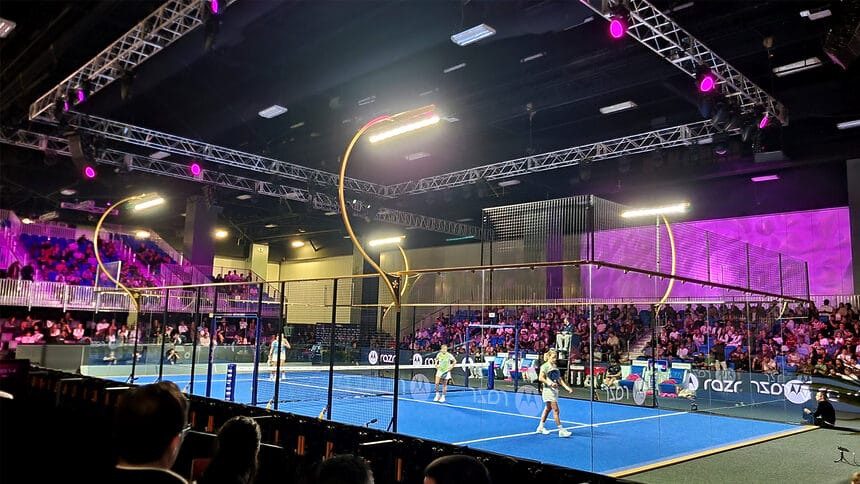
Miami, a tournament… and a breakthrough
The Miami P1 2026 is not just a milestone on the Premier Padel calendar. Its installation at the Miami Beach Convention Center also puts an old debate back at the heart of the season: how to read performance when the environment becomes much more stable? For the pure context of the tournament, our article on the Miami P1 tournament 2026 main draw details the immediate sporting stakes. Here, the angle is different: what indoor changes, in very concrete terms, in the way we play, analyze and prioritize levels.For several weeks now, the circuit has been offering sequences more exposed to the elements, with all that this implies in terms of adjustments. Miami offers something different: a clearer reading of the balance of power. Not necessarily an “easier” padel, still less a “fairer” padel in absolute terms, but a frame in which certain qualities stand out more clearly.In Miami, indoor racing redefines performance benchmarks
Before going into detail, one point needs to be made very clear: returning to the indoor setting in Miami doesn’t just change the atmosphere of the tournament. It reshapes performance benchmarks and brings certain qualities to the fore from the very first exchanges.| Feature | Detail |
|---|---|
| Reading the game | With no wind or changing light, trajectories are easier to read and players can rely on more consistent reference points. |
| Technical execution | The quality of first volleys, returns, lobs and transition shots stands out more in a stabilized environment. |
| Taking the initiative | Pairs able to impose their tempo quickly at the net can capitalize more directly on their automatisms. |
| The need for precision | The indoor environment may give the impression of comfort, but it also punishes errors of positioning, timing or tactics more quickly. |
| Reading performance | Level differences often become clearer, fuelling debate about what a breakthrough performance under controlled conditions really means. |
Why indoor resets the love meter
In an indoor arena, the player no longer has to negotiate the wind, variations in natural light or temperature differences that change the feel of the ball from one match to the next. This doesn’t eliminate uncertainty, but it does shift the focus. Quality of execution becomes central once again: precision of the first volley, reading of rebounds against the glass, timing on balls above the shoulder, ability to string together quickly between defense and taking the net.This turning point favors pairs who live well in tempo. Indoors, the ball “speaks” faster. Trajectories are clearer, but there’s less time to blow out poor preparation. Hesitation on a bandeja, a slightly late changeover, an ill-judged chiquita: all pay off more quickly. At this level, visual impression counts for a lot. An indoor match may appear more fluid, almost cleaner. In reality, it demands a very high level of concentration.An advantage for the cleanest teams in the smallest detail
The great benefit of indoor play, for observers and staff alike, is that it highlights micro advantages. The pair that serves better doesn’t automatically win, but it does retrieve an environment that penalizes its intentions less. The pair that blocks better at the net or closes the angle better on the first volley sees its automatisms rewarded more directly.In this context, the return of serve takes on particular importance. A well-played return of serve is not just a neutral return: it’s often the first shot to refuse the opponent’s set-up. The same logic applies to defensive lobs. Outdoors, a lob can sometimes depend on the weather. Indoors, it must above all live on its intrinsic quality: height, depth, landing zone, reading the response from behind.In other words, the Miamian setting puts the spotlight back on technically controlled padel. Not padel without power, far from it, but padel where raw power doesn’t overshadow precision. Big hitters can obviously do damage, especially if the ball is flying. But without adjustment, indoor padel is no more forgiving: it also exposes excesses.Indoor styling doesn’t erase styles, it breaks them down.
This is where the debate gets interesting. We are often a little too quick to contrast outdoor padel, supposedly more “adaptive”, with indoor padel, supposedly more “pure”. The reality is more nuanced. Controlled conditions don’t make all matches the same. Above all, they give styles a clearer court of expression.Pairs who like to lock the net can impose their point geography faster. Teams that excel in transition, with a taut first volley or a low vibora, gain extra leverage. Conversely, players who thrive on disorder, on variation imposed by the wind or slightly floating balls, sometimes lose some of that improvisational space.This return raises a fundamental question: what exactly is “the best pair” in a given week? The one that dominates in a stable environment? The one that adapts to everything? Or the one that manages to shift its identity from one context to another? Miami won’t definitively settle this debate, but it will make it much more visible.A tournament that refines performance analysis
In the short term, an indoor tournament like this tends to clarify performance. For coaches, video analysis becomes more usable because the noise from the outside is reduced. For players, reference points are more consistent from one round to the next. Finally, for the public, the differences in level can be seen more clearly in certain patterns: the quality of the first touch, holding the net, efficiency on points lasting less than ten seconds, the ability to convert an offensive phase.But it’s important to avoid shortcuts. A very good indoor result doesn’t say everything about a team. It says something important about its level of execution, its tactics, its decision-making speed. It doesn’t necessarily say how that same pair will react when visual cues are blurred, when the ball travels less well, or when the climate forces them to play dirtier, more patient, more opportunistic.In this sense, Miami acts almost as a laboratory test within the season. The word is not pejorative. It simply means that certain variables are more under control. And when the variables tighten, technical responsibility goes up a notch.Behind Miami, a fundamental question of playing conditions
This week in Florida is about more than just the spectacle. Professional padel is still finding its balance between global identity and diversity of conditions. This is also what makes the circuit so rich: the same duo doesn’t tell exactly the same story depending on whether they’re playing under a roof, at altitude, in the humidity or facing an irregular wind.Miami’s return to indoor racing comes at an opportune moment. It reminds us that performance is never an isolated figure, nor a simple score. It’s always linked to the context of the game. And the more padel becomes a global sport, the more strategic this question becomes: how can we compare weeks, how can we judge the continuity of a pair, how can we prepare athletes capable of dominance without depending on a single setting?For the best, the challenge is there. Not to choose between indoor and outdoor, but to build a level that travels. Miami will serve as a breakthrough. It will show which teams know how to accelerate without becoming disunited, how to defend without suffering for too long, and how to impose their structure when the frame offers almost no excuse. In this respect, the American tournament is worth more than a line in the rankings: it puts performance padel back at the center of the conversation.Key takeaway
- The move to indoor racing in Miami puts the focus back on execution quality and tactical precision.
- More stable conditions make performance more legible, without erasing stylistic differences.
- The net, the first volley, the return of serve and lob management should be even more important.
- A good indoor result is a good indication of technical control, but does not sum up the value of a pair over the season.
Further Reading
Table of Contents
- Miami, a tournament… and a breakthrough
- In Miami, indoor racing redefines performance benchmarks
- Why indoor resets the love meter
- An advantage for the cleanest teams in the smallest detail
- Indoor styling doesn’t erase styles, it breaks them down.
- A tournament that refines performance analysis
- Behind Miami, a fundamental question of playing conditions
- Key takeaway
- Further Reading